Noise Abatement
Flight Tracking & Complaints
Orlando Flight Tracker is a web-based tool that allows the public to follow, capture and review flight activity in the vicinity of their homes, schools and businesses in near-real time. Noise complaints may also be filed from this site. Our goal is to provide you with useful information about flight operations taking place at Orlando International Airport (MCO) and Orlando Executive Airport (ORL). We invite you to learn, share and stay in touch.

To access Orlando Flight Tracker, please click on the link below.
Click the link below to file a noise complaint.
Aviation Noise Abatement Committee (ANAC)
The Aviation Noise Abatement Committee (ANAC) is scheduled to meet quarterly at Orlando International Airport, and members of the public are welcome to attend to ask questions or share concerns.
The next Aviation Noise Abatement Committee (ANAC) meeting is scheduled to be held on Friday, October 9, 2026 at 10:00 AM to 11:30 AM in Conference Room Konstan at the Orlando Executive Airport GOAA Administration Building, located at 365 Rickenbacker Dr. (directions).

Updates
At the request of the Federal Aviation Administration (FAA), the Greater Orlando Aviation Authority is sharing information regarding upcoming changes to aircraft arrival procedures at Orlando International Airport (MCO).
Beginning July 15, 2026, the FAA will implement new GPS-based arrival procedures, known as Established on Required Navigation Performance (EoR) procedures, for aircraft arriving at MCO. These procedures will continue to utilize historically established flight paths while incorporating advanced performance-based navigation technology designed to enhance safety and improve operational efficiency within the airspace surrounding busy airports.
For additional information, please contact the FAA Southern Region Noise Ombudsman at 202-267-8507 or 9-aso-noise@faa.gov.
ANAC Agendas and Minutes:
Previous meetings may be viewed under Sunshine Meetings on our Airport Business page.
Please review our Noise Abatement Brochure, and if you still have questions, please contact the Noise Abatement Officer, submit a comment via our Noise Complaint Form or sign up to receive Noise Alerts via email.
Questions, Comments, & Complaints
Program
The Noise Abatement Programs in place at MCO and ORL achieve noise exposure reductions through establishment of:
- Operational procedures
- Federal legislation
- Compatible land use plans
The GOAA noise abatement program brings together all stakeholders to reduce noise and educate the public regarding operations at its airports. MCO has a number of voluntary noise abatement procedures that have been in effect since the late 1970’s and early 1980’s, including:
- Preferential runway use favoring south flow operations
- Assigned headings on departures to the north
- Nighttime noise abatement headings
- Designated engine run-up areas
Noise abatement measures at ORL define specific helicopter approach and departure paths to minimize flights over residential areas.
- Nighttime Preferred Runway
- Nighttime Touch and Go Operations
- Fly Friendly Helicopter Routes
The Federal Aviation Administration (FAA) has sole authority and responsibility for routing and separating aircraft throughout the National Airspace System, and their first priority is always the safe and efficient separation and routing of aircraft. At any time, weather conditions, operational needs or day-to-day airfield maintenance may prevent the implementation of noise abatement procedures.
Information concerning aircraft activity and noise exposure at specific sites can be obtained by contacting 407-825-2674 or submit a comment via our Noise Complaint Form.
While safety is paramount to all air traffic operations, noise sensitivity to the surrounding communities is also of key importance. The following information describes the voluntary noise abatement procedures and typical aircraft routings that are in place at MCO.
Preferential Runway Use (18L/R, 17L/R)

When conditions permit, the FAA will conduct south flow operations. Arriving aircraft are depicted in Red, and the departing aircraft are depicted in Blue.

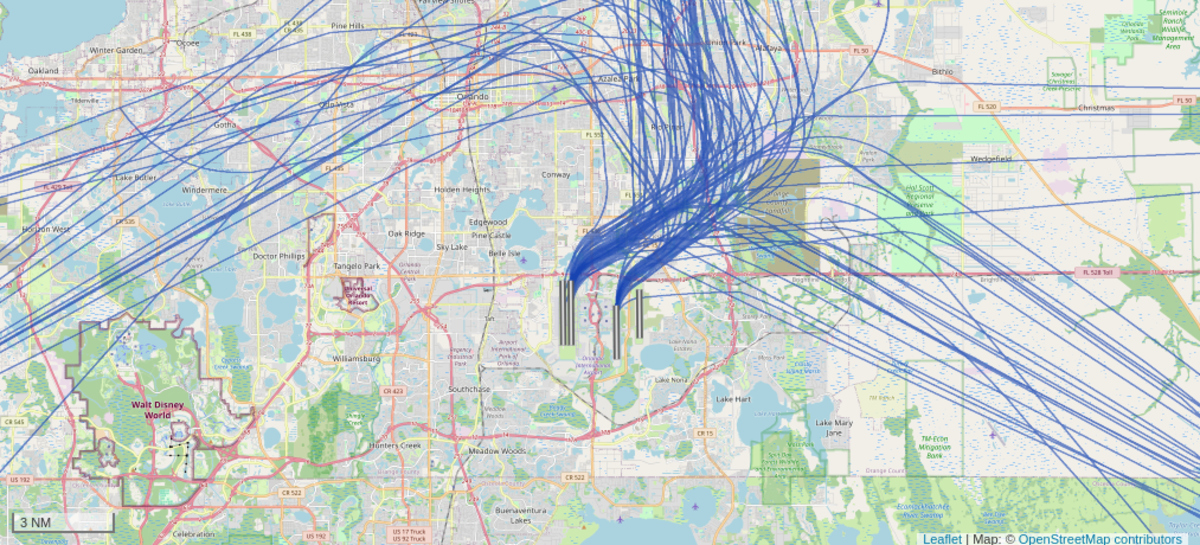
The image below depicts actual flight tracks at MCO over a period of 24 hours during north flow operations. Arrivals are depicted in red; departures are depicted in blue.

Nighttime noise abatement routes are in place during north flow operations. Between 11:00 PM and 7:00 AM, departing aircraft will be directed to the east on climb-out, away from long-established communities.
The Federal Aviation Administration (FAA) is solely responsible for the control of aircraft traffic (Air Traffic Control-ATC) inside the U.S. National Airspace System (NAS). The Authority operates an Aircraft Noise and Operations Monitoring System (ANOMS) that provides noise and flight tracking information.
Have you ever wondered just how busy Florida skies are? Take a look at 24 hours of flights in just over two minutes, beginning at KMCO – Orlando International Airport. Click the link below.
The FAA regulates the maximum noise level that an individual civil aircraft can emit through requiring aircraft to meet certain noise certification standards. Each noise certification standard is designated as a different Stage in the U.S. Any aircraft that is certified for airworthiness in the U.S. must also comply with noise standard requirements to receive a noise certification. The purpose of the noise certification process is to ensure that the latest available safe and airworthy noise reduction technology is incorporated into aircraft design and enables the noise reductions offered by those technologies to be reflected in reductions of noise experienced by communities. As noise reduction technology matures, the FAA works with the international community to determine if a new stringent noise standard is needed. If so, the international community embarks on a comprehensive analysis to determine what that new standard will be.
GOAA has acquired property and implemented a sound insulation program in high noise exposure areas to improve the compatibility between off-airport land use and aircraft overflight activity. Local governments have enacted ordinances that require future development to be compatible with aircraft noise exposure. In addition, certain areas around MCO and ORL are subject to avigation easements (establishing the right of unobstructed flight in specified airspace), waiver of claim, and/or notice of aircraft activity. These represent forms of notification that overflights occur today or will occur in the future as a result of growth in aircraft activity and planned runway development. It should be noted that there are off-airport areas affected by aircraft operations that do not include a site specific notification.
The Aircraft Noise overlay district is intended to protect the health, safety and welfare of persons and property in the vicinity of Orlando’s two airports. Click on the airport code to view the noise environments arising from flight operations at MCO and ORL. Information on airport noise impact areas is available at Orange County Land Development, and at Municode.
Information on airport noise impact areas is available at Orange County Land Development, and at Municode
Responsibilities
The Aviation Noise Abatement Committee (ANAC) has 10 voting members representing both impacted and non-impacted communities as well as technical and Aviation Authority appointed members. The Committee also has non-voting members representing various government entities and a Noise Abatement Officer. Members and the Noise Abatement Officer may be contacted via the Noise Office at: 407-825-2674 or by e-mail to the: Noise Abatement Manager
The Federal Aviation Administration (FAA) has the authority and is responsible for controlling aircraft noise by regulating source emissions. The FAA’s Air Traffic Control has the authority to implement noise abatement operational procedures which have been recommended by the airport proprietor and have been shown to be consistent with air safety and all legal requirements.
The Greater Orlando Aviation Authority (GOAA) is responsible for planning and implementing actions designed to reduce the effect of noise on residents of the surrounding area. Such actions include noise abatement procedures, land acquisition and other controls that do not discriminate, create an unsafe situation, impede the management of the air navigation system, or interfere with interstate or foreign commerce.
Noise Abatement FAQ
Depending on where you live, aircraft may be flying overhead as a result of standard air traffic control procedures. Traffic patterns are designed to allow safe and efficient operations within our nation’s navigable airspace. Routine airfield maintenance or weather conditions may require changes in traffic flow patterns.
For safety reasons, airplanes land and take-off into the wind and must follow published procedures and air traffic control routing and sequencing instructions. Arriving aircraft will typically line up with the runway many miles away then make their final descent approach to the runway via a three–degree glide slope from the runway end. This translates to about 300 feet of descent altitude for every mile flown. In other words, if an aircraft is three miles from the arrival end of the runway its altitude will be approximately 900 ft.
Aircraft have different climb capabilities due to their size, payload, engines and aerodynamic performance. Large aircraft will often appear lower and slower than smaller ones even when they are travelling at the same altitude and air speed. Altitudes are assigned by ATC throughout the route of a flight to ensure that aircraft remain separated from one another.
The FAA is solely responsible for the routing and sequencing of aircraft in the airspace and on the ground. Once an aircraft departs from an airport, the airport no longer controls the movements or actions of the aircraft.
No. Although the FAA and the Greater Orlando Aviation Authority coordinate activities frequently, airspace control and management is the sole responsibility of the FAA. Any change in departure or arrival flight paths can only be approved and implemented by the FAA.
No. MCO operates 24/7. The airport cannot restrict access to various aircraft types, nor can it impose operational restrictions outside of federally mandated requirements.
The FAA uses computer modeling to predict the noise impacts (in decibels) generated by aircraft operations. When measuring aircraft noise levels in a community, a 10db penalty is added to aircraft operations conducted between the hours of 10:00 PM and 7:00 AM.
Most notable during nighttime, departing aircraft to the North will be directed to the east on climb-out away from long-established communities. This procedure has been in place since the 1980’s.